

Congress May Have Finally Found a Better Path for Boxing

The Muhammad Ali American Boxing Revival Act could bring structure, competition, safety and opportunity to boxing—without sacrificing the fighter protections the sport still needs.
Boxing has needed real reform for decades.
Fighters sit inactive. Rankings are difficult to trust. Champions are divided across multiple organizations. Promoters protect records, major fights arrive years too late, and fans are often left trying to determine who the real champion actually is.
The Muhammad Ali American Boxing Revival Act of 2026 may offer a serious path toward changing that.

I have been critical of any system that could weaken fighter independence, and I will continue to be. But I am also willing to recognize a promising idea when I see one.
This legislation could be one of the most important boxing reforms introduced in years—if its protections work as intended.

The Opening Bell: Boxing Needs Reform
There is plenty to love about boxing’s traditional structure.
It has produced legendary fighters, historic rivalries, unforgettable venues and some of the greatest individual stories in sports. That history deserves to be preserved.
But we cannot romanticize a system that has repeatedly failed fighters and fans.
Professional boxing still suffers from:
Too many championship belts.
Confusing and sometimes manipulated rankings.
Long periods of fighter inactivity.
Promotional and broadcast barriers.
Protected undefeated records.
Uneven medical standards.
Limited financial transparency.
Inconsistent state regulation.
Major fights happening after their value has diminished.
Little long-term protection for most fighters.
Boxing does not need to remain broken simply because we have become accustomed to its dysfunction.
Structure is good. Competition is good. Fighter protection is mandatory.
A Bipartisan Boxing Bill Moves Into the Senate

On July 30, 2026, Senators Jacky Rosen of Nevada and Ted Cruz of Texas introduced a bipartisan Senate version of the Muhammad Ali American Boxing Revival Act.
The proposal follows the House effort led by Representatives Brian Jack of Georgia and Sharice Davids of Kansas.
The House bill, H.R. 4624, passed the House on March 24, 2026. The Senate proposal was introduced with several differences that would eventually have to be reconciled with the House version before legislation could reach the president.
The publicly released Senate introduction draft still displayed a placeholder rather than an assigned Senate bill number when reviewed for this article.
That distinction matters: this proposal has not become law.
According to Senator Rosen’s office, the bipartisan measure is intended to allow voluntary, league-style organizations to operate alongside traditional boxing promoters while strengthening health, safety and financial protections for fighters.
Boxing reform should not belong to one political party, promoter or corporation.
Nevada’s involvement is especially important. Las Vegas remains one of professional boxing’s most significant markets, and the state understands both the economic value of major fights and the importance of athletic regulation.
What Is a Unified Boxing Organization?
The legislation would establish a legal framework for what it calls a Unified Boxing Organization, or UBO.

In plain language, a UBO could function more like an organized boxing league.
It could contract fighters, operate events under unified rules, create rankings and establish championship pathways for the boxers within its system. The Senate proposal also allows a UBO to recognize titles and rankings produced by independent organizations.
Participation would be voluntary. Fighters who do not choose the league structure could remain within the traditional boxing marketplace.
That is one of the proposal’s most important features.
A new boxing system should create another path—not destroy every path already available.
What the Revival Act Could Provide
Under the Senate proposal, a qualifying UBO would be required to meet a series of professional, medical and contractual standards.
Among the provisions contained in the released text:
A minimum payment of at least $200 for every scheduled round.
At least one covered fight every six months—or a required payment when the organization does not provide that opportunity, subject to listed exceptions.
A maximum three-year term for a boxer’s first professional promotional agreement.
A general contract limit of six years.
The right to communicate with another promoter or UBO during the final 90 days of a contract.
Medical insurance for injuries suffered while training for a covered fight.
Access to training and rehabilitation facilities at reasonable costs.
A medical coordinator to assist fighters with licensing and medical requirements.
Additional examinations following a knockout.
Supplemental annual examinations for fighters 40 and older.
An additional ambulance and licensed physician at covered events.
A comprehensive anti-doping program using independent testing.
Public disclosure of rating criteria, policies and appeal procedures.
Restrictions against UBO officials holding a financial interest in a fighter’s management.
Prohibitions against betting by fighters and other individuals directly involved in a match.
Those are not minor details.
They address several areas in which fighters have been vulnerable throughout boxing history: inactivity, unclear rankings, medical expenses, one-sided contracts and the concentration of control over a boxer’s career.
Why I Support the Direction of This Bill
I have experienced boxing as a youth boxer, amateur, Masters competitor, coach, cornerman, promoter, ringside announcer and writer.
I have watched what the sport can do for a person. Boxing teaches discipline, courage, accountability and the ability to remain composed under pressure.
I have also seen the dysfunction surrounding it.
I have seen talented fighters struggle to remain active. I have seen young boxers and their families enter the professional business without understanding contracts, management relationships or the true economics of a fight.
I have no interest in protecting a broken structure just because it is the structure we grew up with.
I am for the better good of boxing as a whole. I do not care whether the solution comes from an old promoter, a new league, Congress, USA Boxing, World Boxing or a completely new organization. If it protects fighters, creates fair opportunities, improves safety and strengthens the sport, I support it.
My standard is simple:
Does it improve boxing without exploiting the boxer?
Why League-Style Boxing Could Work
Organization is not the enemy of boxing.
A properly built league could give fighters more regular dates, clearer advancement and a better understanding of what they must accomplish to earn a championship opportunity.
It could also give fans:
Rankings they can understand.
Recognizable championship pathways.
More consistent matchmaking.
Better season-long storytelling.
Fewer meaningless belts.
More reliable access to important fights.
A clearer picture of who is competing at the highest level.
The current promotional system often depends on separate companies agreeing to risk their investments against one another. That is one reason elite matchups become delayed, over-negotiated or abandoned completely.
A league containing a deep roster could make quality matchmaking easier.
That does not mean every league will automatically be good. It means the model deserves a fair opportunity to prove itself.
Exploitation is the enemy—not organization.
Competition Must Remain
The strongest version of this legislation would create more competition across boxing.
It should allow UBOs to operate alongside:
Traditional promoters.
Independent managers.
Regional promoters.
Major broadcasters.
Smaller streaming platforms.
Independent championship organizations.
Fighters who choose not to enter a league.
Competition gives fighters leverage.
A boxer should be able to compare guarantees, opponents, contract terms, sponsorship rules, career plans and long-term benefits before deciding where to sign.
If one organization becomes the only meaningful destination, fighters will eventually lose bargaining power regardless of how attractive the system looked at the beginning.
The bill succeeds if it creates more choices. It fails if it eventually produces one unavoidable choice.
The Fighter Protection Test
A league structure should never require the boxer to surrender the independence that made Muhammad Ali larger than any promoter or championship organization.
Before I fully trust any UBO, I want to see whether its fighters can:
Use truly independent managers.
Understand every contract provision.
Receive meaningful financial disclosures.
Negotiate their compensation.
Protect reasonable sponsorship rights.
Maintain ownership of their personal brands.
Leave after a fair contract period.
Challenge ranking decisions through a transparent appeal.
Receive legitimate medical protection.
Understand exactly how rankings are determined.
Avoid perpetual extensions and contractual control.
Maintain a real voice in their career decisions.
The Senate text contains valuable protections, including a firewall between a UBO and fighter management, contractual time limits, a 90-day negotiation window and ratings disclosures.
Those protections must be enforced in practice—not merely placed on paper.
What This Could Mean for Young Fighters

Every year, young boxers emerge from USA Boxing, the Golden Gloves, national championships, Local Boxing Committees, World Boxing competition and Olympic qualification.
Many are ready to fight.
Far fewer are prepared for the professional business.
A credible league could give those fighters:
Structured development plans.
Reliable competition.
Medical oversight.
Minimum professional standards.
Financial education.
Career-transition support.
A visible road from prospect to contender.
Greater protection against predatory agreements.
That could be particularly valuable for fighters who do not arrive with a famopromoter, powerful manager or built-in social-media following.
Talent should matter.
Development should matter.
The ability to sell tickets should not be the only factor determining whether a young fighter receives an opportunity.
The Zuffa Question
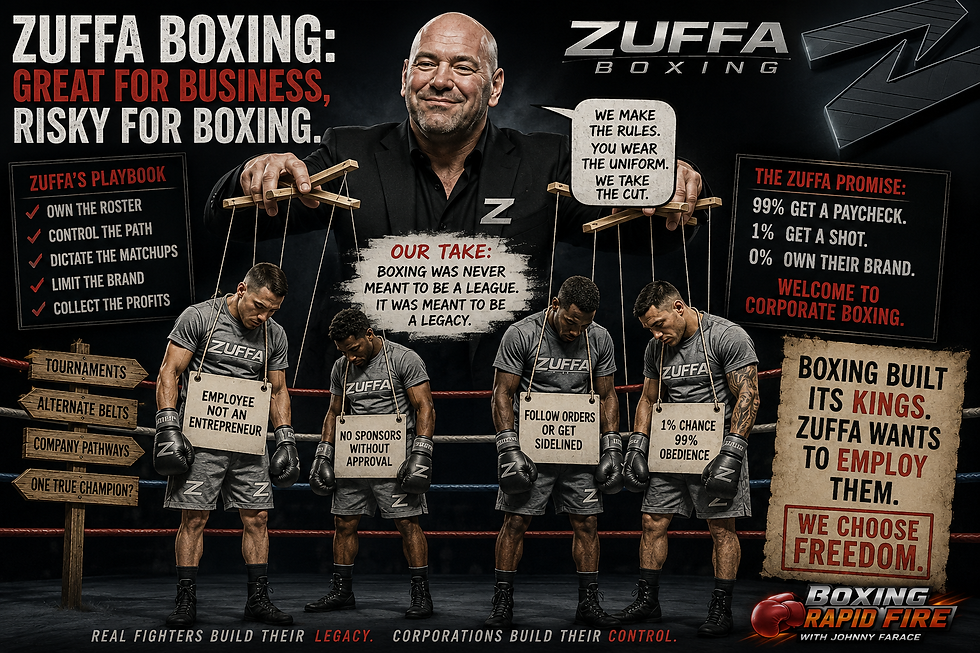
People may expect me to oppose this legislation simply because Zuffa Boxing could benefit from the UBO framework.
That is not my position.
My previous criticism has concerned efforts that might weaken, bypass or work around the fighter protections created by the original Muhammad Ali Boxing Reform Act.
This new legislation must be judged by its actual language, enforcement and results.
If Zuffa Boxing provides fighters with reliable activity, meaningful matchups, strong medical protection, transparent rankings and fair compensation, then its involvement could help the sport.
If it attempts to dominate the marketplace, weaken independent management, restrict personal branding or control both sides of a boxer’s career, I will criticize it just as directly.
I will judge Zuffa by what it does, not simply by what it calls itself.
I am not against new investment. I am not against innovation. I am not against league boxing.
I am against any system that improves the company by weakening the fighter.
The Muhammad Ali Standard
Muhammad Ali was never merely an athlete operating inside somebody else’s system.
He represented fighter independence, identity, courage, economic power and the right of an athlete to speak for himself.

He became larger than the promoters, sanctioning organizations and institutions surrounding him.
Any legislation carrying his name has a responsibility to strengthen the boxer—not merely the boxing company.
That must be the standard.
The Ali name should represent:
Fighter protection.
Fighter opportunity.
Fighter independence.
Financial transparency.
Personal identity.
Freedom from coercive control.
If a new league helps produce another Muhammad Ali inside the ring while preventing that boxer from becoming Muhammad Ali outside the ring, then the system has failed.
What Success Would Look Like
Five years after implementation, successful reform would mean:
Fighters compete more regularly.
Minimum compensation improves.
Medical standards become stronger.
Rankings become easier to understand.
Elite fighters face one another earlier.
Young professionals receive better development.
Fighters receive clearer financial information.
Several promoters and leagues compete for talent.
Fans understand the championship pathways.
The boxer remains the central asset.
Failure would look very different.
The legislation would fail if one company controls every meaningful opportunity, fighters cannot leave, independent managers disappear, sponsorship rights are stripped away or rankings become promotional tools.
It would also fail if the new standards become so expensive or difficult to navigate that responsible regional promoters are pushed out of the sport.
Boxing needs reform, but it still needs a healthy regional foundation. Local shows, independent gyms and smaller promoters are where most professional careers begin.

The Final Bell
Boxing does not need another political war between old promoters and new organizations.
It needs adults in the room who are willing to examine each idea honestly and decide what is best for fighters, trainers, gyms and fans.
The Muhammad Ali American Boxing Revival Act may create structure where boxing has operated in confusion. It may produce competition where fighters have had too few options. It may establish medical, contractual and professional standards that should have existed decades ago.
That deserves serious support.
But support does not mean surrendering accountability.
Every league, promoter, manager and sanctioning body must answer the same question:
Does the system serve the fighter—or does the fighter exist only to serve the system?
I am for the better good of boxing as a whole.
If this legislation protects fighters, creates opportunity, increases competition and strengthens the sport, then I am behind it.
Let the traditional promoters compete. Let the new leagues compete. Let the broadcasters compete. Let the best ideas win.
Most importantly, let the fighter have a real choice.
Johnny Faraće is a lifelong boxer, trainer, cornerman, promoter, ringside announcer and member of the inaugural Masters Boxing International Hall of Fame Class of 2026.
Comments